
Detectable and Targetable
Vance Boelter, the seven-marker catalog, and what it would have taken to detect him on the public record before June 14, 2025.

§1 The question
Not whether Vance Boelter acted alone. The federal record is sealed and likely stays sealed.
This piece answers a different question: what would it have taken to detect someone like Boelter on the public record before June 14, 2025?
That is a methodology question. Every threat-assessment researcher, every commercial microtargeting platform, and every intelligence-recruitment trainer has been answering some version of it for fifty years, using the same underlying mechanism.
§2 What happened
Friday, June 13, 2025. Boelter handed his housemate David Carlson $900, four months of rent in advance. He sent a text: “I love you guys and I’ve made some choices. I may be dead shortly. I wish it hadn’t gone this way.”[1]
Hours later. 2:00 AM Saturday. Boelter knocked on State Senator John Hoffman’s door impersonating a police officer. Eight gunshots into Hoffman. His wife Yvette wounded pushing the gunman out. At 3:30 AM Boelter killed State Representative Melissa Hortman and her husband Mark in their Brooklyn Park home. He carried a target list of 70 names with residential addresses and family information. A vehicle modified with emergency lights and police-grade tactical configuration.[1]
§3 Who Boelter was
In February 2025, Boelter quit his funeral-home job moving bodies, citing a mental-health crisis. He was 57. Married, four children.[2]
Before February, Boelter was a working-class manager. Greencore, Del Monte, Johnsonville Sausage, 7-Eleven general manager. Decades of food-industry work. [2] He was also a pastor with a church in the Democratic Republic of Congo.[2] He served seven consecutive years on the Minnesota Governor’s Workforce Development Board across two Democratic administrations, overlapping for four years with State Senator John Hoffman.[3] Carlson described him as anti-abortion but said religion “wasn’t the thing that defined him.” Boelter voted for Trump and generally avoided talking about politics.[2] His wife told FBI investigators they identified as “preppers” with a “bailout plan.”[1] He had no documented training in law enforcement, military, or private security.[2]
Between February and June, his bank accounts emptied. He posted his LinkedIn #opentowork banner and applied for food-service work.[2]
§4 The mechanism, named and applied
Change the environment, watch behavior shift.
Tversky and Kahneman demonstrated this in 1981 with physicians and graduate students. They presented the same disease-treatment statistics two ways: “200 of 600 lives saved” versus “400 of 600 lives lost.” Identical mathematics. Opposite preferences. The risk-averse framing produced one choice, the risk-seeking framing the other. Framing was everything.[4]
Robert Cialdini named six levers in 1984 that move humans more reliably than reasoning: reciprocation, authority, scarcity, commitment, liking, social-proof. He drew them from door-to-door sales floors, fundraising boiler rooms, and intelligence-recruitment programs.[5]
Thaler and Sunstein changed 401(k) enrollment from opt-in to opt-out at one company. Participation jumped from 37% to 86%. Same plan, same employees.[6] The federal Pension Protection Act of 2006 spread the discipline nationwide.
Beshears and Kosowsky published a 2021 meta-analysis. They pulled every paper in Elsevier’s Scopus database that cited the foundational nudge work and reported new-data treatment effects with at least ten citations. 174 papers. 965 distinct nudge effects. The effect held across health, environment, finance, and prosocial behavior. Nudges that automated part of the decision (opt-out defaults, automatic enrollment) outperformed those that asked the person to choose actively.[6]
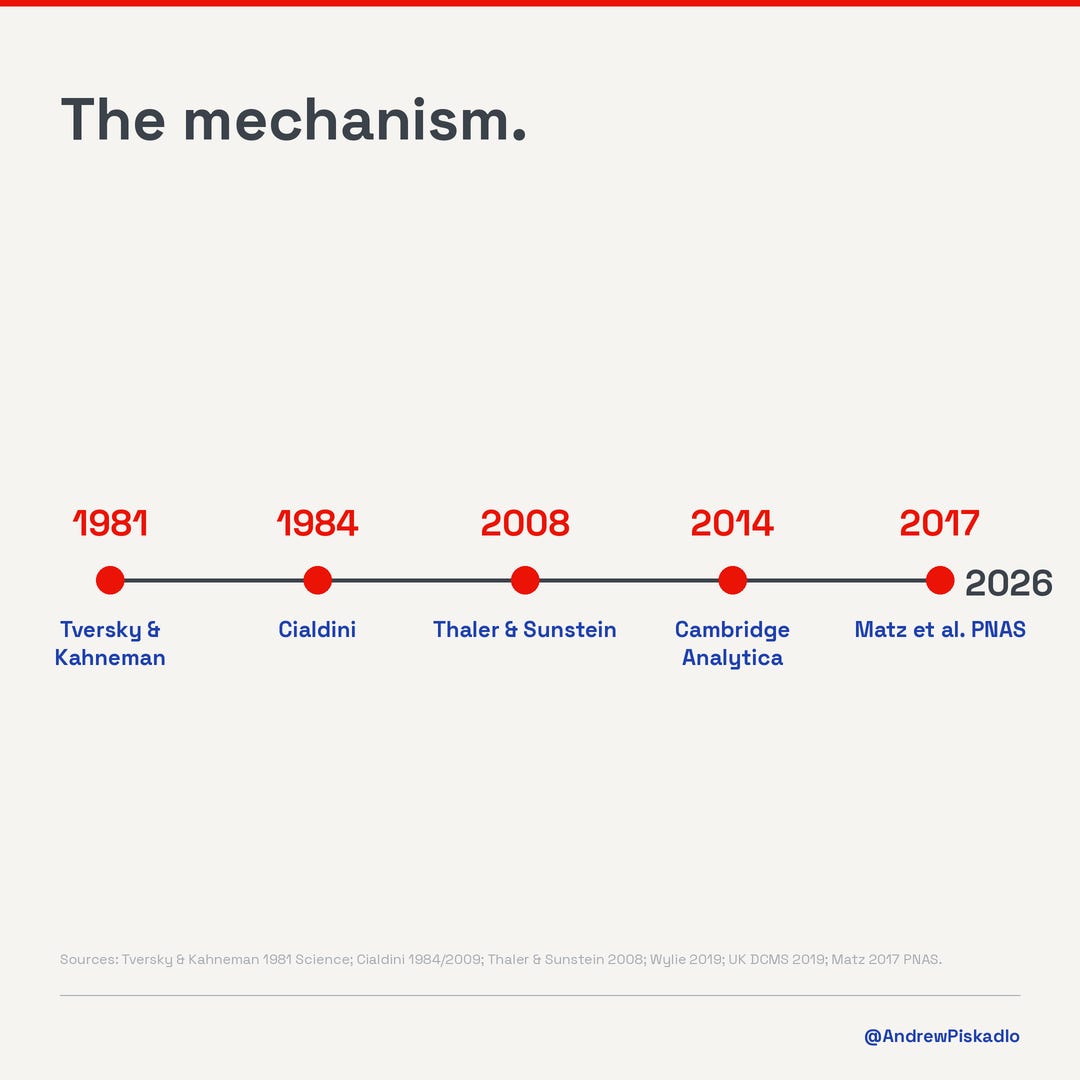
Cambridge Analytica took Cialdini’s six and applied them at scale. Beginning in 2014, researcher Aleksandr Kogan deployed a Facebook quiz called thisisyourdigitallife. Approximately 270,000 paid users took it. Facebook’s API at the time allowed apps to harvest friends-of-users data, which pyramided the harvest to an estimated 87 million profiles. The data was sold to Cambridge Analytica via Kogan’s company Global Science Research. Cambridge Analytica built OCEAN personality models on the harvest (openness, conscientiousness, extraversion, agreeableness, neuroticism) and deployed psychographically-tailored political ads.[7] The next year Matz, Kosinski, Nave, and Stillwell validated the underlying mechanism in PNAS: three real-world field experiments reached 3.7 million users; psychologically-matched ads outperformed mismatched ads on clicks and purchases at p < 0.001.[8]
CIA case officers learn Cialdini’s six as the mnemonic RASCLS and apply them across a six-phase recruitment cycle: Spotting, Assessing, Developing, Recruiting, Handling, Turnover.[9] Hedge funds extract signals from market behavior. Marketers identify in-market consumers. Political campaigns identify persuadable voters.
Same engine, two operating modes. Forward direction: start with a goal and find the people whose signals match. Cambridge Analytica did this for vote intent. A consumer-goods company does it for purchase intent. Reverse direction: start with an event and ask what signals the actor exhibited that could have made them findable in advance. Detection. Deployment. The mechanism is the same; the question is inverted.
§5 Seven markers
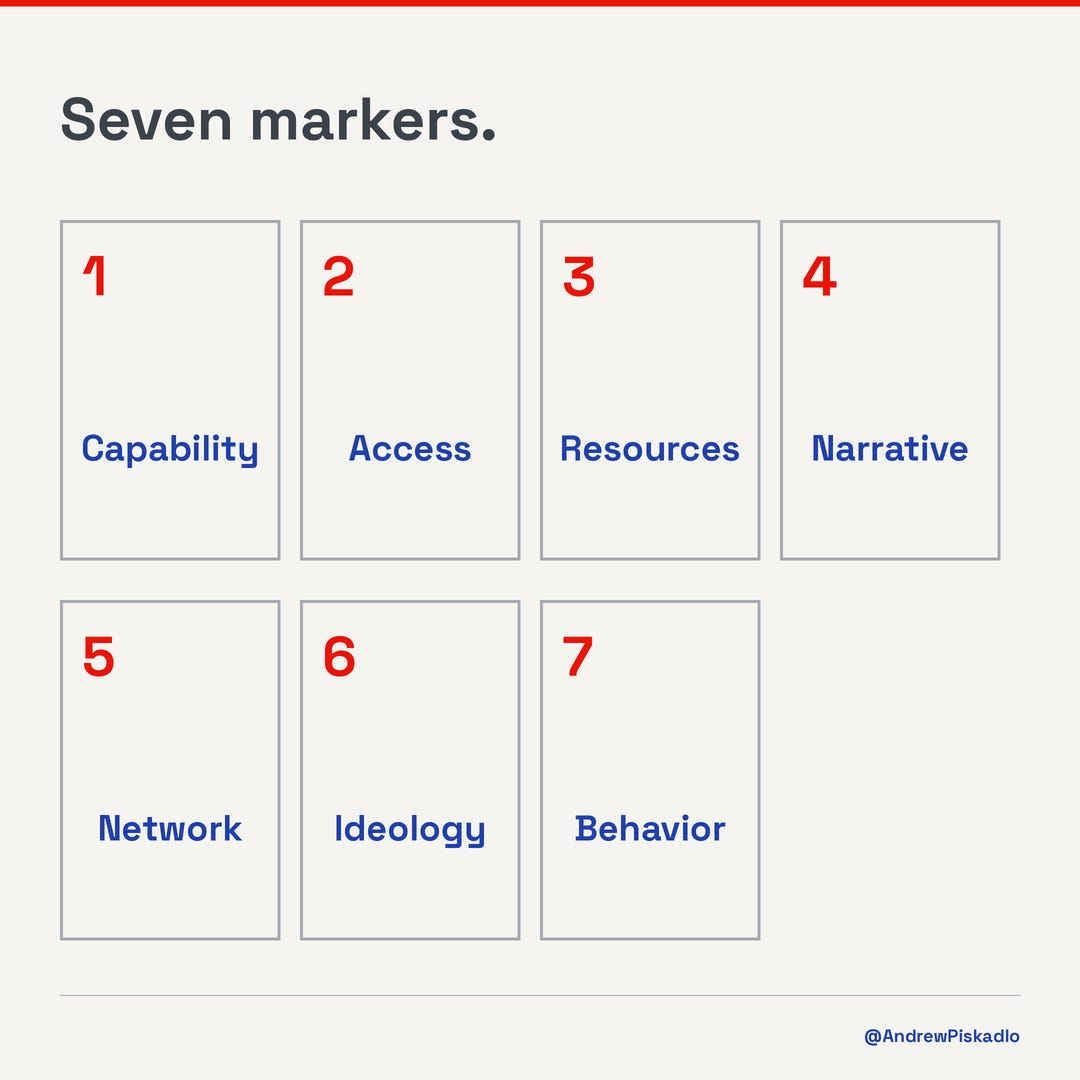
A useful catalog for the reverse direction starts with seven coarse categories. Each is a question public-record evidence can answer about an actor before the operational date.
1. Capability-timeline acceleration. Is operational sophistication consistent with documented skill acquisition?
2. Institutional access anomaly. Does access match background and political affiliation?
3. Resource-provision pattern. Are equipment, funding, or training present that the financial baseline cannot account for?
4. Narrative-reality discrepancy. Does the official story survive primarysource contact?
5. Network-topology disruption. Did the actor’s network change in patterns consistent with handler contact or pre-attack isolation?
6. Ideological-cover mismatch. Does stated motivation explain target selection?
7. Behavioral-trace anomaly. Do digital and physical movements during the period before action match baseline behavior?
§6 Boelter, scored
1. Capability-timeline acceleration: PRESENT. Multi-target operational sophistication acquired in four months from a food-industry baseline. No documented training in law enforcement, military, or private security.[2]
2. Institutional access anomaly: PRESENT. Seven consecutive years on the Minnesota Workforce Development Board across two Democratic administrations despite minimal engagement and Republican voter registration. Four-year overlap with Hoffman.[3]
3. Resource-provision pattern: PRESENT. Praetorian Guard Security Services LLC: shell company, no clients, no service record, phone connected to a private residential line, registered address listed as a divorce-litigation law firm, advertised “police-type vehicles” matching the attack methodology. Carlson: “That was some fantasy.” Storage locker rented June 10 held empty rifle cases and guncleaning supplies.[2] [1]
4. Narrative-reality discrepancy: PRESENT. Governor’s office: doesn’t know Boelter. Boelter from jail to NY Post August 2025: detailed personal China discussions with the governor, who “personally reappointed” him.[10]
5. Network-topology disruption: PARTIAL. Pre-event social withdrawal documented. Handler-pattern contacts unknown at current evidence access. Storage locker access code last used the day before the attack.[1]
6. Ideological-cover mismatch: PRESENT. Anti-abortion motivation cited. Carlson said Boelter hadn’t spoken about abortion in years. A 70-name target list of state legislators with insider-knowledge residential addresses does not follow from the stated motive.[2]
7. Behavioral-trace anomaly: UNKNOWN. Requires platform-behavior records not in the public docket.
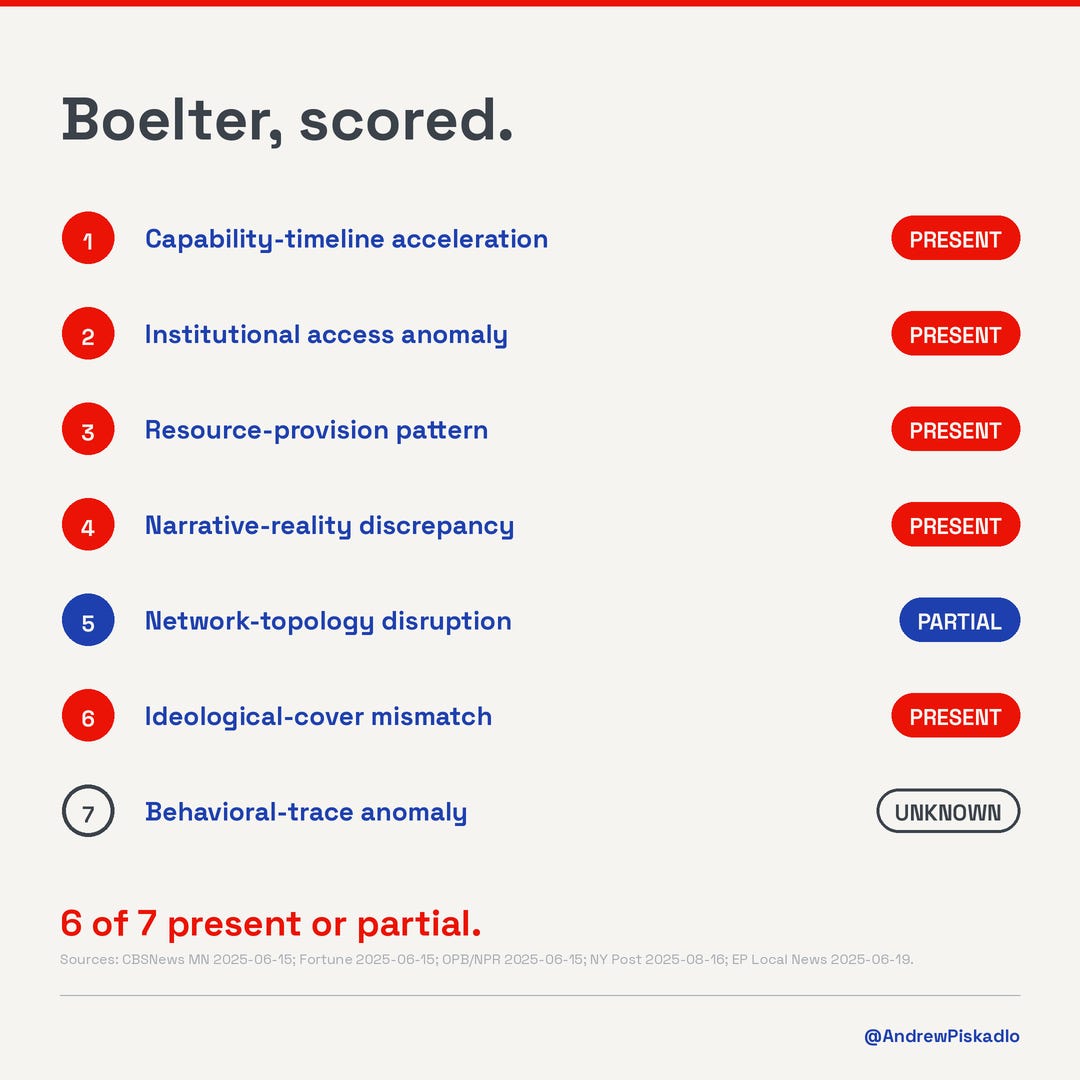
Six of seven categories present or partial. Investigation-worthy.
§7 Anomaly, not origin
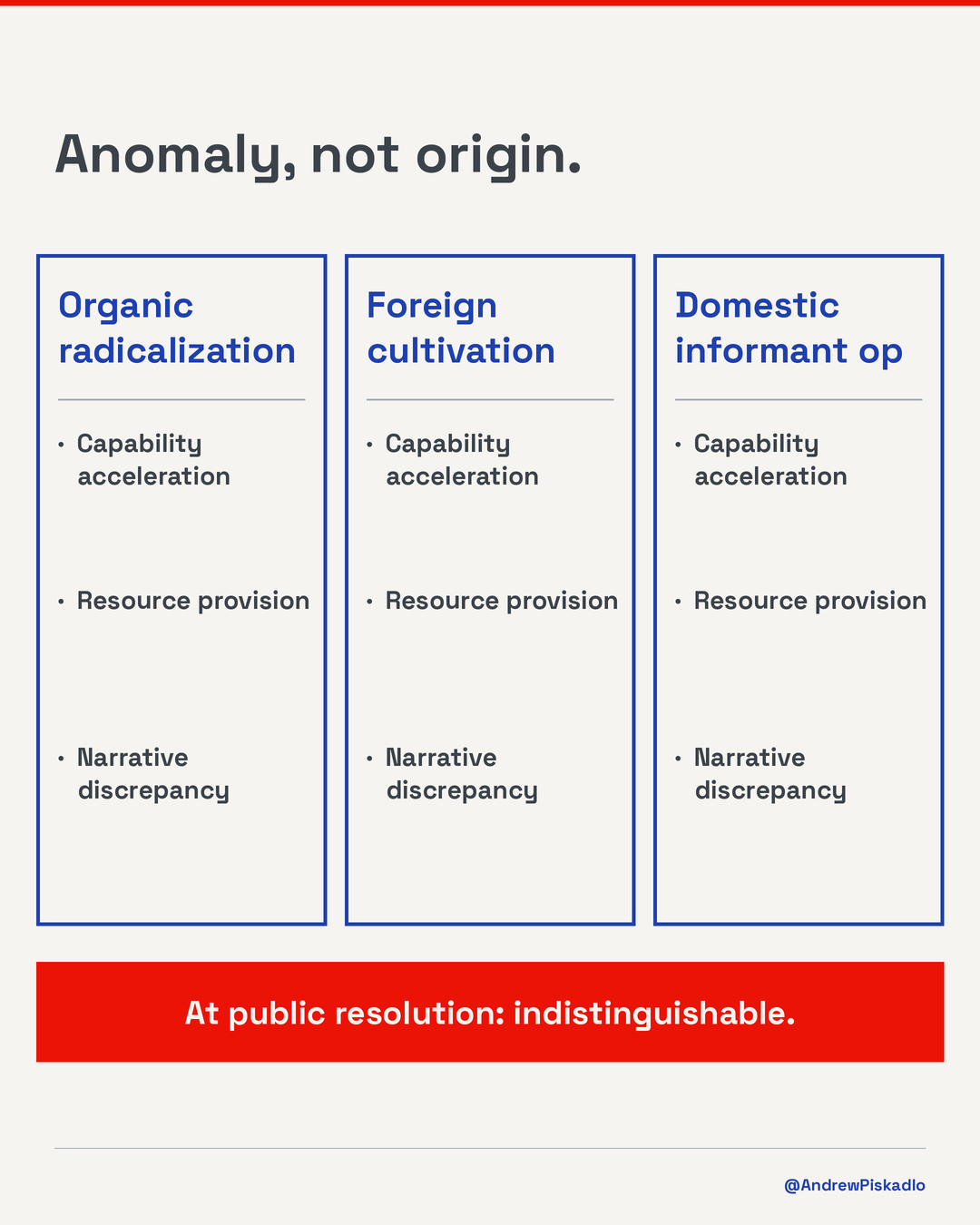
The catalog identifies anomaly. It does not identify origin.
Three hypotheses produce a similar indicator pattern. Organic radicalization with self-acquired capability. Adversarial cultivation by a foreign intelligence service. Domestic informant operation where capability was provided by handlers rather than self-acquired, well-documented in post-9/11 federal sting prosecutions.[11]
At public-record resolution, the three are indistinguishable. A methodology that claimed otherwise would not survive a Daubert hearing.[11]
§8 The same engine, forward
A consumer-goods company asks: who is in the moment that makes them buyable for the new analgesic, the new diagnostic, the new tool? A campaign that asks what does this person watch, eat, listen to, work on, worry about? answers a better question than every campaign still running 1980s precinct-walking on shit partyregistration databases.[12]
Microtargeting leverages data that already exists and a half-century of humanpsychology research to get more done with fewer resources. Iran does not build aircraft carriers to fight the US Navy. It builds drone air forces and missile cities. A deep-tech founder will not out-spend Pfizer in clinical trials or out-engineer Intel in fab capex. Asymmetric is the only direction. Fight where they are weak. Leverage what already exists. Find the buyer who has been waiting for what only you can build.
The methodology was never only about catching someone like Boelter. The same lever runs everywhere the mechanism applies. Direction and discipline are the only differences.
Detectable, in retrospect, on the public record alone. Targetable, in prospect, by anyone with the catalog, discipline, and the desire to look.
Sources:
[1] Boelter operational record and FBI affidavit detail. CBS News Minnesota 2025-06-15 (prepper / wife affidavit / storage locker contents / Hoffman family statement). AP 2025-06-14 timeline. OPB/NPR 2025-06-15 (Carlson reading text).
[2] Boelter biographical baseline, employment, and NPR review of fabricated security credentials. OPB/NPR 2025-06-15 ibid. Fortune 2025-06-15, “Work history financial problems.”
[3] Workforce Development Board service and Hoffman overlap. Eden Prairie Local News 2025-06-19. CBS News Minnesota Walz-connection 2025-06-15. Star Tribune 2025-06 fact-check.
[4] Tversky & Kahneman 1981. “The Framing of Decisions and the Psychology of Choice,” Science 211:453-458.
[5] Cialdini six principles. Cialdini, R. 1984/2009, Influence: The Psychology of Persuasion. Cialdini & Goldstein 2004, Annual Review of Psychology 55:591-621.
[6] Thaler/Sunstein default-setting and Beshears/Kosowsky meta-analysis. Beshears, J. & Kosowsky, H. 2021, “Nudging: Progress to date and future directions,” Organizational Behavior and Human Decision Processes 161 Suppl, 3- 19. Madrian & Shea 2001 401(k) finding (37% to 86%) summarized in Beshears 2021 §1.
[7] Cambridge Analytica primary accounts. Wylie, C. 2019, Mindf*ck: Cambridge Analytica and the Plot to Break America. Kaiser, B. 2019, Targeted: The Cambridge Analytica Whistleblower’s Inside Story. UK DCMS Parliament 2019, Disinformation and ‘Fake News’ Final Report.
[8] Matz et al. PNAS validation of psychographic targeting. Matz, S.C., Kosinski, M., Nave, G., Stillwell, D.J. 2017, “Psychological targeting as an effective approach to digital mass persuasion,” PNAS 114:12714-12719.
[9] CIA recruitment cycle and RASCLS. Burkett, R. 2013, “An Alternative Framework for Agent Recruitment: From MICE to RASCLS,” CIA Studies in Intelligence 57(1). US Army FM 2-22.3 2006, Human Intelligence Collector Operations.
[10] Boelter jailhouse contradictions with Walz office position. NY Post 2025-08-16. Star Tribune fact-check ibid.
[11] Three-hypothesis ambiguity and Daubert defensibility. Kamali, S. 2017, “Informants, Provocateurs, and Entrapment: Examining the Histories of the FBI’s PATCON and the NYPD’s Muslim Surveillance Program,” Surveillance & Society 15(1): 68-78. Aaronson, T. 2013, The Terror Factory: Inside the FBI’s Manufactured War on Terrorism. Jacobson v. United States, 503 U.S. 540 (1992). DellaVigna & Linos 2020, “RCTs to scale,” NBER WP 27594.
[12] Forward-direction commercial and political microtargeting. Hersh, E. 2015, Hacking the Electorate: How Campaigns Perceive Voters, Cambridge University Press. Issenberg, S. 2012, The Victory Lab: The Secret Science of Winning Campaigns. Moore, G. 2014, Crossing the Chasm 3rd ed. and Inside the Tornado.